Overview
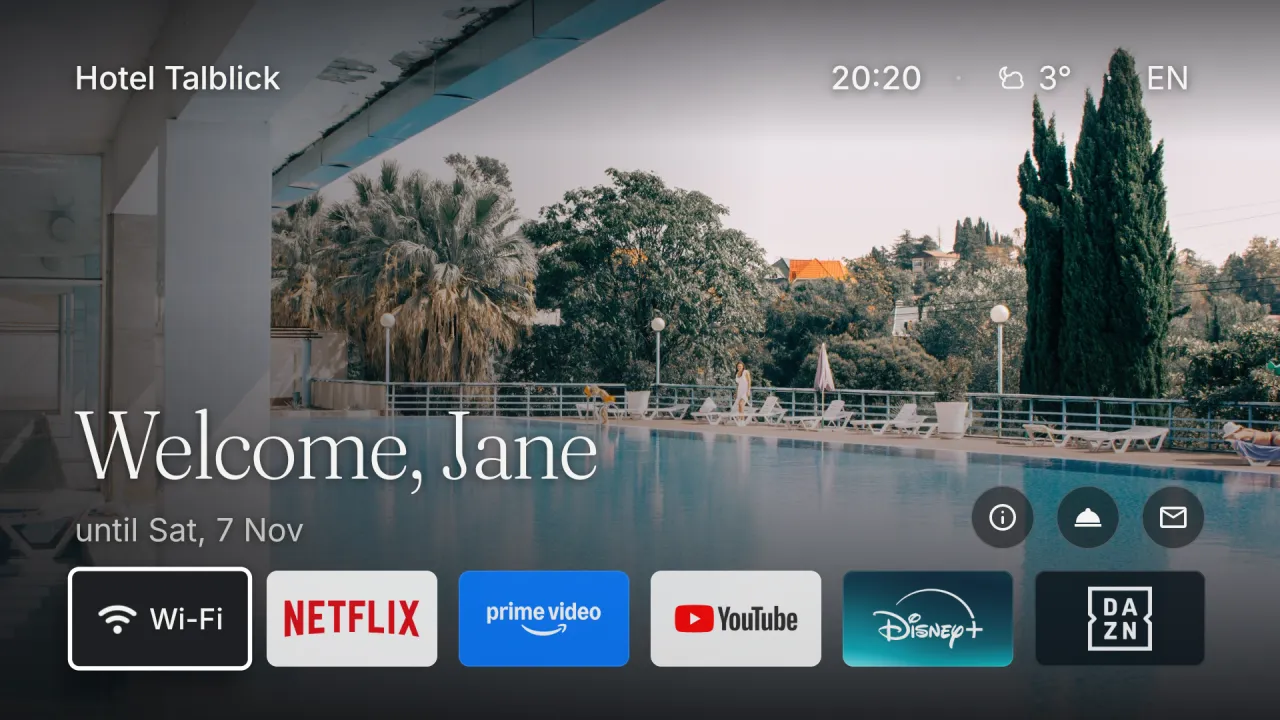
Hospano is a guest TV platform for hotels and serviced apartments, sold as a product to properties from 10 to 300 rooms, starting with the DACH market. An Android TV box on the room's TV shows guests a branded welcome screen with their name, stay dates, hotel info, Wi-Fi QR code, weather, streaming apps and live TV, where guests sign in to their own Netflix, YouTube or Disney+ accounts.
The core promise is privacy: when the guest checks out in the hotel's PMS, every trace of them is removed from the TV automatically and verifiably, a signed wipe receipt is stored, and the TV goes to standby. The next guest gets a clean device. I built the whole system: the Android TV app, the NestJS backend with an MQTT broker, the Next.js admin panel, a provisioning tool for technicians, and the server setup.
Key Features
Verified Guest Wipe
At checkout or room move, app data of every streaming app is cleared through Device Owner APIs and checked, and a per-app receipt is sent to the server. If the box is offline at checkout, a local alarm wipes it after a grace period anyway.
PMS Integration
Check-in, stay updates, extensions, room moves and checkout arrive as signed webhooks from hotel PMS systems, or by polling for systems that do not push. A stay state machine decides when a wipe is needed and when the same guest just stays.
Guest Home Screen
Compose for TV launcher with a personal welcome, streaming app row, live TV through the TV's own tuner, Wi-Fi QR, weather, hotel info pages, a video and photo gallery from the hotel's NAS, service requests, wake-up alarms and emergency messages.
Real-Time Fleet Control
Every box keeps an MQTT connection over TLS. Configuration is a versioned desired-state document per device, and one-off actions (wake, standby, message, reboot, logs) are typed commands with results, reaching the TV in under 5 seconds.
Silent OTA Updates
New APKs roll out silently per hotel or per box, with hash and signing certificate checks, installs during standby, and automatic pausing of a release when devices report a crash loop after the update.
Admin & Front Desk
Operators manage the whole fleet, hotels, plans, releases and wipe reports; hotel staff get their own users for front desk check-in/checkout, guest requests, housekeeping and TV control, limited to their own hotel.
Android TV App
The TV app is written in Kotlin with Jetpack Compose for TV and is its own Device Owner: one APK acts as policy controller, launcher, sync engine and UI, with no third-party MDM. A technician turns a fresh box into a managed device with an ADB provisioning tool, and the box then enrolls itself to a hotel and room.
A reconciler applies the desired state step by step (stay, branding, policies, power schedule, release) and every action is idempotent, so it is safe to run twice. The device never executes arbitrary code from the server; every remote action is an allow-listed, typed command. TV power and volume are controlled over HDMI-CEC, or over the TV's LAN API on hotel-mode TVs. The app uses Hilt, Coroutines and Flow, the HiveMQ MQTT 5 client, Media3 ExoPlayer and DataStore.
Backend & Infrastructure
The NestJS backend on TypeORM and MySQL 8 normalizes PMS events into stays, builds and publishes each device's desired state, tracks commands and wipe receipts, ingests health and crash telemetry, and raises alerts (for example a wipe not confirmed within 10 minutes, or a box offline while a guest is staying). Delayed jobs and retries run on BullMQ and Redis.
Devices talk to a Mosquitto broker with per-device credentials and ACLs managed through its dynamic security plugin. Shared MQTT payloads and REST DTOs live in a typed contracts package with JSON Schemas, used by the backend and the admin panel. The monorepo (pnpm + Turborepo) is deployed to a VPS with PM2 behind Apache, and broker and API endpoints can be migrated to a new domain without touching boxes in the field.
Admin Panel
The admin panel is built with Next.js, TypeScript and shadcn/ui, with live device status over WebSocket and two-step login with TOTP. It covers the fleet view with bulk commands, device detail with desired vs. reported state, hotels with branding, plans, channel lists and wipe package lists, rooms, enrollment and pairing, stays with raw PMS history, wipe reports, staged release rollouts, a price calculator and a test PMS for simulating check-ins and checkouts. The interface is translated with next-intl.
Technologies
Android TV App
Kotlin
Jetpack Compose for TV
Device Owner (DPC)
Hilt
Coroutines & Flow
HiveMQ MQTT 5
OkHttp
Media3 ExoPlayer
DataStore
WorkManager
Coil
HDMI-CEC
Backend
NestJS
TypeScript
MySQL
TypeORM
MQTT
Mosquitto
Redis
BullMQ
JWT + TOTP
Swagger
Jest
PM2
Apache
Admin Panel & Tooling
Next.js
React
TypeScript
shadcn/ui
Tailwind CSS
WebSocket
next-intl
pnpm
Turborepo
JSON Schema
ADB